Showing posts with label Ladybird. Show all posts

Wednesday, 7 May 2014

Week 16: Not so Dandy

As the yoof would say, I proper overdid it last week. Bouncing bunnies, rare butterflies and merry mothing adventures were a Lepidoptera too far. I’ve had to scale back a little this week. Evidently, the curative powers of nature take a while to kick in. So, this post is all about Dellfield, or at least, the bits of it I could identify and photograph yesterday. In fact, in a glass half full kind of a way, scaling back has the advantage of forcing you to look more carefully and patiently at what you can access, and put that which is off limits to one side.

Ever since capturing the Oak, with the mass of yellow dandelions in the foreground, I have been waiting for the right weather and the seed heads to develop, in order to repeat the shot. Unfortunately, Monday night’s heavy rain drenched and destroyed many of the fluffy, white orbs I’d hoped to include. C’est la vie. You can only photograph what’s there. It’ll be orchid season soon anyway… So, we have, the not so dandy Dandelions...


If you’d like to see how a dandelion goes from flower to seed head, take a look at this great, time lapsed video clip.


Pretty pink/purple Bush Vetch (Vicia sepium) is coming into flower now and is dotted all around Dellfield. On the common nettles, Small Tortoiseshell larvae (caterpillars) are emerging from their communal webs, built after hatching (left). They will continue to construct these webs as and when they move on, before, finally, individually finding a suitable site for pupation. By the middle of the summer, metamorphosis complete, the new butterflies will start to free themselves from their chrysalides.


My search for life (of a non-alien form) kept me glued to the stinging nettles (where else?!) (ouch). They are all around the fringes of Dellfield and are, as ever, teeming with invertebrates, including a couple of easily missed, day flying, Small Yellow Underwing moths (Panemeria tenebrata). According to Butterfly Conservation, they fly “actively in sunshine visiting flowers such as dandelion and buttercup.” Neither of the specimens I found had read the literature and were on Cow Parsley (Anthriscus sylvestris) instead (below).


As I walked the west side of Dellfield, a male Blackcap kept me company with his scratchy song which was occasionally overlaid with the fluty melody of a Blackbird. Up in the trees, a pair of Kestrels were busy doing spring time things and overhead the resident pair of Buzzards were calling and soaring. In the midst of this, I came across a 14-spot Ladybird (Propylea 14-punctata). This is a native, british species and is about half the size of the more familiar 7-spot Ladybird (Coccinella 7-punctata). My photograph (right) won’t win any prizes but I was chuffed to capture the opening of the protective wing casings before lift off.

There are at least 2 pairs of Green Woodpeckers around Hay Wood. One pair was up in Barnfield yesterday. The male (nice red “moustache”) was stabbing the moist earth with his tough bill, trying to get at a food source. He will mainly feed on ants but he could have been after other insects. I just managed to photograph him before the pair of them flew to trees in Ryders. That superb yellow-green rump glowed in the brilliant sunshine. I'll keep my eyes peeled for baby 'peckers over the coming weeks.


Finally, a cautionary tale. Should you ever find yourself in a field of Spring flowers, about to crouch down to inspect a bee on a dandelion, make sure you check its wingman hasn’t landed on the back of your leg (almost just behind your knee, say). Wingman bee stung me, even through thick denim jeans, but it served its purpose. At the first “prickle”, I stood up quickly and the bee flew off, apparently not squished by my squatting on it. I was very relieved not to have caused inadvertent death and the bee sting is only mildly itchy now. All’s well that ends well.

Finally, finally, before I forget, Ben is hoping to run the moth traps again this evening at Box Moor. You’ll be able to catch up with the results on his blog, later this week.

Wednesday, 9 April 2014

Week 12: Ladybirds and Creepy Crawlies

The thick pea soup, sloshing around inside my skull where my brain should have been for the past 4 weeks, is slowly but surely giving way to a firing neuron or two. Don’t get too excited though. The process of composition is still faltering and glacial. Let’s just say you’re exceedingly fortunate not to receive the words in real time. Truly! You. Are.

I have been on the look out for ladybirds (Coccinella septempunctata) for a few weeks and finally discovered one of their hang outs. In a patch of succulent stinging nettles, by the north entrance to Dellfield, I unearthed numerous seven-spots (more than a dozen).


I was particularly careful not to disturb them. Why? Well, according to the internet literature, if these little creatures are startled or threatened, they secrete a foul smelling, toxic fluid (hemolymph) from their leg joints. If a predator is unlucky enough to encounter a Ladybird larvae, it will be faced with even worse, an abdomen oozing the sticky alkaloids. Grim. Best to steer clear of gobbling up brightly coloured red and black beetles. They are decidedly unpalatable and most birds, and other potential predators, will know (or quickly learn) to avoid meals that come in red and black packages.

A little more about Ladybirds before I move on. Traditionally, they are a gardener’s friend. They feed on all the little “pests” that vegetable and flower growers seek to be rid of: white flies, aphids, scale insects, mites and so on. In fact, legend has it that the prefix “lady” stems from this beneficent role. In the middle ages, European crops were plagued by pests. Farmers prayed to the Blessed Lady, the Virgin Mary, and along came Ladybirds, ridding the crops of the infestations and saving the Farmers’ livelihoods. From then onwards, the beetles became known as Lady Beetles or, in Germany, Mary Beetles (Marienkafer). The name eventually morphed into Ladybirds and Ladybird Bettles.

If you’re scared of spiders, beware the next few photographs. Once you get down and dirty in a patch of stinging nettles you will find all sorts of marvellous creepy crawlies. I lost count of the number of Nursery web spiders which had positioned themselves in warm, sunny spots on nettle leaves. I also came across this curious tiny “thing” (photographed right). It was approximately 2mm in length and, according to the clever people on the internet, it is a mummified aphid. Essentially, a parasitoid wasp has laid its egg in the aphid. I wonder if a Ladybird will come along and eat both the aphid and the incubating wasp egg *shudder*. I’m reminded of the song “I know an old lady who swallowed a fly”...perhaps it isn’t so unrealistic after all.

Clearly, the nettles were the place to dine. A common species of hoverfly also turned up, which was no doubt on the look out for aphids as well. (To enlarge the photographs, just click on them).

    Nursery Web Spider
    Hoverfly (Platycheirus albimanus)
    Nursery Web Spider


It was all too easy to get absorbed into the microcosm of life within the nettles. But, elsewhere, all around the moorland, there are glowing Meadow Buttercups (the photograph below was taken on Station Moor)


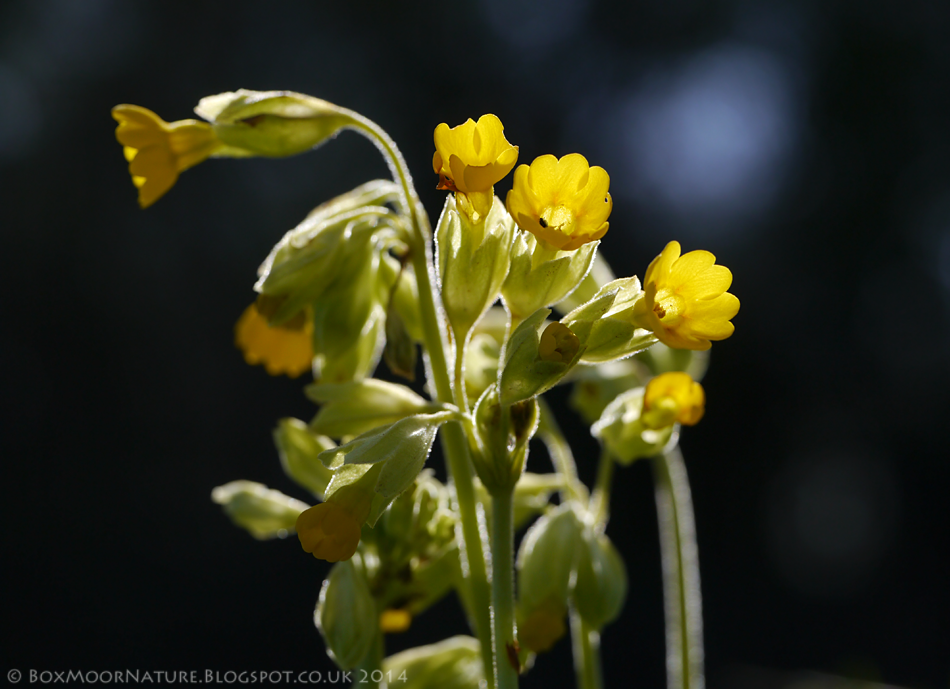
Not far from where I found the Forget-me-not last week, a profusion of beautiful Hidcote Comfrey has burst into life. And, Cowslips are out in abundance now. Dellfield, the London Road verge (along Snook's Moor), and the Bovingdon Brickworks are suffused with the tiny yellow flowers.

    Hidcote Comfrey (Bovingdon Brickworks)
    Cowslips (Bovingdon Brickworks)

Walking through Snoxall's Moor, it's hard not to notice the pair of striking trees (photographed below, left). From a little research, I think they are Acer pseudoplatanus (Sycamore Maple) but happy to be corrected, if anyone can help. Whatever they are, when caught in the right light, they look most elegant and dramatic. Finally, to this week's Oak photograph. I can't say it's a roaring success but in as much as I wanted to capture the Cowslip-rich slope, leading down to the Oak, it works. As a footnote, for the birder in me, I've included a shot of the Grey Heron which frequents the canal by Bulbourne Moor.

    Acer pseudoplatanus
    Dellfield Oak
    Grey Heron