Showing posts with label Reflections. Show all posts

Saturday, 15 November 2014

Week 43: Dapper Caps including Fly Agaric

More fruiting fungi for you this week although lack of brain power means that I shall have to leave the detailed reading up to you, if you fancy it. As a complete fungi foraging novice, it will come as no surprise that at the top of my list of hoped for species around Box Moor was the Fly Agaric. It is the archetypal mushroom with that beautiful white-spotted red cap, and….I had never seen it.

Last Sunday, enticed out by a little sunshine, I drove up to The Old Barn at Westbrook Hay. I hadn’t even reached the car park when I spotted what could only be Fly Agaric, growing by the side of the entrance track. To say I was quite chuffed is to put it mildly and I can understand Pat O'Reilly’s response whenever he finds a specimen, “my heart leaps and I experience yet again the intense feeling of amazement that came over me so many years ago when for the first time I saw this fabulous fungus in a forest.” I guess the sight of it is a bit like walking into a fairy tale. As children, we had perhaps assumed that along with the fairies, Smurfs and frog-princes this mushroom was part of the unseen world of imagination. To be faced with its very real existence, in perfect fairy tale form, is rather wonderful. 

In terms of its place within the wider ecosystem, Fly Agaric forms mycorrhizal associations with many different plant and tree species i.e. it enhances the availability of beneficial nutrients to its host. It isn’t one of the saprobic, nutrient recyclers, from last week. If you’re interested in finding out more, Pat’s article is excellent and well worth dipping into. 

Unfortunately, by Wednesday this week, someone/something had destroyed all of the specimens by The Old Barn. I did find another in Ramacre Wood but that too had been kicked/destroyed.

Fly Agaric (Amanita muscaria)
Cap diameter approx 130mm


 King Alfred's Cakes (Daldinia concentric)
Width approx 60mm
Clouded Agaric (Clitocybe nebularis)
Cap diameter approx 160mm
 Rosy Bonnet (Mycena rosea)
Cap diameter approx 30mm


Monday morning, full of enthusiasm after my fairy tale find, I returned to Westbrook Hay for more foraging. This time I focused on Ramacre Wood. I won’t go into detail about each fungus but will put links in to further reading at the end if you’re interested. The majority of species were recyclers i.e. saprobic (scavengers feeding off and recycling the nutrients of dead wood and leaf matter). A few were mychorrhizal or more specifically ectomychorrhizal. All 3 photographed above are saprobic.

After hours spent in the field, it’s always nice to come across something a little different, such was my luck on Monday. It turns out that there’s a white variant of the otherwise brown Jelly Ear (Auricularia auricula-judae) and it is fruiting well in Ramacre Wood (if “fruiting well” is the appropriate fungi lingo for “there’s a whole lot of it”?!). It isn’t scientifically significant and doesn’t seem to be anything to get particularly excited about (according to this thread) but it was interesting nonetheless.

Jelly Ear (Auricularia auricula-judae)
Width approx 50mm


Jelly Ear & what was previously known as Albino Jelly Ear (Auricularia auricula-judae var. lactea)
Width of largest brown growth approx 60mm


Later in the week, I called in at Roughdown Common and found a few more fungi, a couple of which are included in the photographs below. Walking out onto Further Roughdown, I was greeted by a swirl of Magpies making for the trees, at least 14, a couple of Green Woodpeckers, a Mistle Thrush, Blackbird, a single Redwing and a mixed Tit flock including 7+ lovely little Long-tailed Tits. Over on Bulbourne Meadow, 4 Red Kites came through, circling high overhead, a Kingfisher called and a couple of Nuthatches probed for food in the Reflecting Willow, which, incidentally, has had a hair cut...


Rooting Shank (Xerula radicata)
Cap diameter approx 45mm, height approx 120mm


 [Roughdown] Inkcap sp
Cap diameter approx 30mm
 Deceiver sp (Laccaria genus)
Cap diameter range 30-80mm
 Russula genus
Cap diameter approx 50mm

 Lepista genus, likely nuda or possibly sordida
[Roughdown] Cap diameter approx 50mm 
Armillaria genus
Cap diameters approx 20mm, 40mm
 Conical Brittlestem (Psathyrella conopilus)
Cap only, diameter approx 12mm


The more I learn about fungi, the more I appreciate that getting to a definitive species identification is frequently impossible without microscopic examination or advanced ecological knowledge. I don’t have either of those tools so some IDs are left at the level of genus.

This week’s fungi list with links to further reading

Fly Agaric (Amanita muscaria) [Entrance track to Old Barn car park & Ramacre Wood]
Clouded Agaric or Funnel (Clitocybe nebularis) [Ramacre Wood & Lower Roughdown Wood]
King Alfred’s Cakes (Daldinia concentrica) [Hay & Ramacre Woods]
Rosy Bonnet (Mycena rosea) [Ramacre Wood]
Jelly Ear (Auricularia auricula-judae) [Ramacre Wood]
Rooting Shank (Xerula radicata) [Ramacre Wood]
Inkcap species [top of dell of Lower Roughdown]
Deceiver species (Laccaria genus) [tree covered path NW edge of Bovingdon Reach meadow & Ramacre Wood]
Russula genus [Ramacre Wood]
Lepista genus, likely nuda or possibly sordida [under Oaks, Lower Roughdown] 
Armillaria genus [path south side of Overbourne meadow, Westbrook Hay]
Pholiota genus [Hay Wood]
Conical Brittlestem (Parasola (Psathyrella) conopilus) [Ramacre Wood & path south side of Overbourne meadow, Westbrook Hay]
Hygrophorus genus possibly lindtneri [under Oaks, Lower Roughdown]
Tubaria genus possibly conspersa (Felted Twiglet) [Ramacre Wood]

And, to round things off, it's this week's Oak photograph. Its leaves are well and truly turning now.

Thursday, 26 June 2014

Week 23: Damsels on the Moor

Thankfully all these damsels (bar one, I think) were male and they weren’t in the least bit distressed, as far as I could tell. Me, a camera and a pair of binoculars wouldn’t have been much use as a means to securing a rescue, I can assure you. This week, I decided to walk the moors (that sounds like something out of Great Expectations but you know what I mean). I ended up spending most of my time opposite the reflecting willow (photographed below), although, out on Harding’s Moor, it was great to see a family party of 4-5 Jays and a male Kestrel drift through. Down at Two Water’s Moor (east), an adult Song Thrush was stuffing its bill with juicy worms to feed to its youngsters.

Back at Bulbourne Moor, I arrived at the willow at the same time as a Kingfisher zoomed up to perch in a branch. From there, it plunged into the water, emerged with a fish and darted off, back down river, to feed its growing family or, perhaps, to sustain the nesting process all over again. Also downriver, I could hear the Grey Wagtail pair calling to one another. I wonder if they’ve bred nearby this year?


Much of my attention was directed towards the small clumps of vegetation, in the river, by the north bank, almost opposite the willow. In one small 1-metre-square area, I spotted 5 different species of damselfly! There were Red-eyed, Large Red (2), Common Blue (2), Blue-tailed (2) (all males), and a single female Banded Demoiselle. In total, along the stretch of river between the willow and where I stood to take the photograph, there were 2 Red-eyed, 1 Banded Demoiselle, 4 Large Red, 10+ Common Blue and 3 Blue-tailed damselflies. A little further down river (just behind me in relation to the photograph above), were 3+ exquisite male Banded Demoiselles. They really are breathtakingly beautiful.


    Banded Demoiselle (male)
    Banded Demoiselle (female)

    Large Red (male)
    Common Blue (male)

    Blue-tailed (male)
    Red-eyed (male)

Photographing all of them without a pair of waders, a swimming costume(!) or a boat was a precarious business. Countless times I nearly ended up as Kingfisher food. The Red-eyed and Blue-tailed damselflies were particularly tricky and simply would not perch within optimum photographic range (anyone would think they were wild and free!). Regardless, they were peaceful and mesmerising to watch, fluttering over the water; taking their time to decide which perch was best; settling and then unsettling; “bumping into” one another and finally settling for longer, before starting the whole “which perch is best” deliberation all over again.

Dragonflies and damselflies belong to a group (or “order”) of insects known as Odonata. Within this order, there are two main types (or “sub-orders”): damselflies (Zygoptera, meaning "paired-wings") and the true dragonflies (Anisoptera, meaning "unequal-winged"). According to the British Dragonfly Society, in damselflies, "[a]ll four wings are near enough equal in size and shape. They are usually small, weakly flying insects that stay close to the water margins or water surface. When at rest, most species hold their wings along the length of their abdomen. The Emerald Damselflies are an exception and usually hold their wings partly open when at rest. They are therefore known as Spreadwings in North America. The eyes are always separated, never touching. The larvae have external plates (lamellae) at the end of the abdomen, which act as accessory gills.” So, there we go. If you'd like to read more about their life cycle and breeding process, there's a lovely article written by Scottish Natural Heritage here.

Eventually, it was nearly time for lunch but, just as I was about to leave, a female Mallard swam up with her 5 ducklings (one was hiding behind the vegetation in the photograph below). Always irresistible!


This week's Oak photograph is a little different. No reason, I just fancied a change.


Finally, as I was crouching by the river this week, it was nice to be greeted with a friendly hello by a local dog owner. A timely reminder that in a couple of weeks, 12th July, there is the fun Box Moor Trust event, Paws on the Moors, aimed at the canine carers who enjoy the land, come rain or shine.

Thursday, 15 May 2014

Week 17: Knowledge & Affection

“A little knowledge is a dangerous thing”. I don’t mean that in the “I’ve read ‘Neuroscience for Dummies’ and can therefore perform life-saving brain surgery” scenario! I mean that once you ignite the spark of curiosity, you could well be hard-pressed to extinguish it. Since spending just 3 hours in the company of lovely mothing enthusiasts, I now find myself scouring the scrub for day flying moths, developing larvae or pupating chrysalides. (I positively glowed at the discovery of Drinker moth caterpillars yesterday at Dellfield. And, I even contemplate leaving the outside light on at night to see what might turn up. What have you done to me Ben/Roger/David?!). Since finding, identifying and researching my first batch of Box Moor Bugs, I am now on the look out for more weird and wonderful creatures. Whatever you do, don’t give me any interesting facts on spiders, otherwise this blog will become disastrously inaccessible to the countless arachnophobes out there. So, beware the peculiar perils of knowledge.

As I write, it is another gloriously sunny day and Box Moor is blooming. It’s a shame I can only capture a tiny snippet of it each week. I took a walk through the Boxmoor moors yesterday morning, finishing up at Dellfield. On the banks of the river Bulbourne, I yielded to my obsession with the reflecting willow. Bulbourne Moor and Meadow are now lush and covered in buttercups, and the willow is a vibrant, celadon green.


Left, 5th March 2014; Right, 14th May 2014

I made my way through Harding’s Moor, where the cattle were taking their role as conservation grazers very seriously; the Green Woodpeckers were yaffling and 2 Grey Herons were perched on the river. Over Station Road and through the handsome herd of horses (more conservation grazers) on Station Moor. The Grey Wagtail pair and a couple of Canada Geese were by the bridge and 3 Swifts circled overhead. Later, on my way back, a family of Starlings were lined up on the bridge railings, with the fledglings begging parents for food.

I amassed innumerable photographs of bugs and beetles (I repeat, beware the perils of knowledge! Don't say I didn't warn you). Below are 3 of the prettier ones. The Green Nettle Weevil on my finger, provides a sense of scale. All of the creatures were between 6 and 9mm long. The first and third were on Harding’s Moor, the second on Station Moor. For more information (if you dare), just click on their names.

    Green Nettle Weevil
    Green Dock Beetle (pregnant female)
    Rhopalid bug (Corizus hyoscyami)

The Belted Galloways were grazing in the sunshine on Herdsman’s Moor, and a flock of Jackdaws were pulling up worms from the rain-soaked earth.


Finally, I reached Dellfield. I had no idea that watching a tree, every week, for 4 months would lead to me developing such a sense of affection for it. When I first caught sight of the Oak yesterday, I was genuinely thrilled to see how much greener it has become. For weeks, from any and every angle, I have been photographing the stark, leafless branches. I know its shape inside out and back to front. I know its form and place within the landscape. Now, as the leaves develop, it is as though I am watching what was the bare bones of a pencil sketch, finally begin to engender soaring colour, defining detail and palpable life. It is surprisingly wonderful and I can’t wait to see the Oak next week.


Left, 26th February 2014; Right, 14th May 2014

Wednesday, 5 March 2014

Week 7: Loose Catkins, Hungry Clouds & Rampant Worms


The title might suggest that instead of searching for fungi, I have kicked off my wellies, settled on a damp log and munched my way through a paper bag full of hallucinogenic mushrooms. I haven't, I promise (I couldn't find any). All will become clear, I hope.

The loudest voices on Bulbourne Moor, Meadow and Harding's Moor this morning were the Wrens and Great Tits, full of Spring vigour, calling as if their chests would burst! The resident male Sparrowhawk was keeping watch overhead and more than a dozen Magpies patrolled the grounds. The Little Egret was leg-waggling its way along its favourite stretch of the River Bulbourne, by Station Road. And, I also spotted a pair of courting Jays in the little wooded area separating Two Waters Moor (west) from Bulbourne Meadow. The male, I presume, was making subdued, short calls whilst extending his body so as to be as straight as an arrow (the two Jay photographs above are the same bird, calling gently).

A handful of Wild Daffodil (Narcissus pseudonarcissus) clumps are flowering now on Harding's Moor and Bulbourne Moor. I neglected to mention the single spray of Crocus flowers last week but that has been trampled and has all but disappeared.


In just 12 days, the Common Alder (Alnus glutinous) male flower catkins have loosened and lengthened, enabling the light yellow-green pollen within, to be released into the air. The female flowers are the compact, red, bud-like flowers just out of focus in today's shot.

    21 February 2014
    05 March 2014

There wasn't a puff of wind, making it ideal to photograph the still waters.

The view across Hardings Moor, towards the KD Tower


Too long spent contorting myself into Twister-type positions in order to get Daffodil photographs, meant that by the time I'd walked back to Bulbourne Moor, the clouds had eaten away at the blue sky and were threatening to take over completely. However, I can't seem to resist this tree (left, a species of Willow, I think?) and its reflections.

The next stop was Dellfield and the Oak. Unfortunately, as I arrived, the biggest black cloud imaginable gobbled up the sun and all drama disappeared from the landscape. The photo above (top, left of the Jay) is essentially the one I had in mind for this week, but, I opted for black and white, emphasising texture, as an alternative to the rich colour and contrast presentation that I had envisaged. I’ll have to wait for another blue-sky day for that.


The biggest surprise of the morning was discovering that, in the course of 7 days, Dellfield had been overtaken by RAMPANT WORMS! I don’t mean that in the racy sense (although, who can be sure when dealing with hermaphrodites?!). No, I mean the field is littered with worm casts. Each deposit is less than a foot away from the next and so on....everywhere! It is impossible to avoid them. Apparently, early Spring and Autumn are indeed worm cast highs. Soil temperature and soil air-to-water ratio are such that the worms are active nearer the surface.


I am genuinely chuffed that I get to write about earthworms this week (yes, I am slightly strange). Detritivores are so important to any ecosystem. They consume dead and decomposing plant and animal matter and, in the case of worms, deposit the digested material back into the soil in the form of casts. These are rich in minerals and very fine in texture and, inevitably, improve the quality of the soil. Linking this back to last week’s post, it is the detritivores which enable a developing ecosystem to move from comprising just the weedy plant species (that can survive in nutrient deficient soil), to attracting the more nutrient-hungry grasses and shrubs. Detritivores are a powerful component of natural succession, essential to improving the health of the soil substrate.

Earthworms are largely nocturnal due to being extremely sensitive to ultraviolet light (rather like vampires, although vampires are fictional, of course). However, during very wet weather, they are sometimes forced to the surface to avoid drowning and have to just hope (if worms can do such a thing?!) that they won’t be burned by the sun. Ordinarily, they venture out of their burrows at night and drag fallen leaves and plant debris down into the soil. This is another way in which they improve the structure of the earth they inhabit.

In terms of propagating the worm race, as wikipedia so romantically put it, “sexual reproduction occurs when two worms meet and exchange gametes, copulating on damp nights during warm seasons [I particularly liked that phrase]. Fertilized eggs are protected by a cocoon, which is buried on or near the surface of the ground.”

Eventually, I tore myself away from marvelling at the wonder of worms and glanced up at the tall Limes (I think) on Ryders (the field west of Dellfield). Perched at the top of the tree was a Common Buzzard (right), coincidentally a big fan of worms....for lunch. This seemed like a fitting end to the morning - thoughts had travelled from the soil, to its nutrients, to the beneficial nocturnal worms, to predator buzzards picking said worms out of said soil. The wonder of the food web.

P.S. Do I get a prize for including the words "detritivore" and "vampire" in the same post?

Friday, 21 February 2014

Week 5/B: Sunny Interlude

The S U N came out and there was more blue sky than fluorescing white cloud today….so….I pushed back a few things in the morning and spent about 40 mins on Bulbourne Moor and Bulbourne Meadow. If nothing else the photos are evidence that it hasn't rained non-stop, all day, every day, for an eternity, although it might feel like it. I fear next week's Oak tree photograph will require waterproofs from head to toe; an umbrella; the ingenious use of plastic bags (for non-waterproof camera) and a third arm.

Snowdrops (Galanthus) & the KD Tower

Bulbourne Meadow Flood

Beautiful Alder Catkins (Alnus glutinous)

Fallen Branches in River Bulbourne

Bulbourne Meadow, River Bulbourne & Bulbourne Moor

Wednesday, 19 February 2014

Week 5/A: Oaks, Galls and Snowdrops

Having made this blog public last week, I shouldn’t have been surprised by the almost immediate and terrifying mild sense of stage fright, and the utterly irrational fear that everything in nature would cease to be “there” for me to explore! It came as a relief, although not a surprise, that Nature was still there today.

A mid-week visit this time. The two main aims of today were to photograph the Oak at Dellfield and the Snowdrops I’d seen growing on Bulbourne Moor (across the road from B&Q). I started with the Oak, stepping out of the car to the sound of a lusty Dunnock and a male Chaffinch belting out his song. Both birds obviously getting a head start on Spring-time pursuits.

I opted for a silhouette of the Oak, with the blue sky loosely reflecting the shape of the canopy.


It occurred to me that I'd not included a close-up of the clustered buds of an Oak. So, I headed up to Preston Hill where I knew there were two mature Oaks with low-growing branches. I’ll try to follow these over the coming weeks, as the leaf buds open up.


The hedgerow along the path down to the pond was alive with Blue Tits and Great Tits. They were likely searching for food or potential nesting material, or simply keeping an eye on territory. A Green Woodpecker was calling, but I couldn’t see it, and a Buzzard was making its rounds overhead.

As I walked towards the woods, I came upon a solitary, young Oak. It still had last year’s leaves hanging precariously from it - very surprising given the strength of recent gales.


Growing out of a leaf bud was an Oak Marble Gall, about 2cm in diameter. I could pretend I knew what it was when I found it but, no, curiosity, resulting in a bit of research (rather than the proverbial cat-killing, thankfully!?!) was the answer.


It is in fact the home of the larvae of a gall wasp, or gallfly, so called because of its ability to stimulate these tissue swellings or galls on plants. They are a large group of wasps in the family Cynipinae (order Hymenoptera), whose eggs, once deposited, cleverly create their own home and food source. Each species of gall wasp produces a distinctive gall, with a particular form and in a specific location. The Oak Marble Gall is, not surprisingly, always found on Oaks and always in a leaf bud, and is created by the gall wasp Andricus kollari. It contains a high concentration of tannic acid and for centuries was an ingredient in the manufacture of iron gall ink, used for writing and dying clothes (just in case you needed a random fact to pull out at dinner parties!)

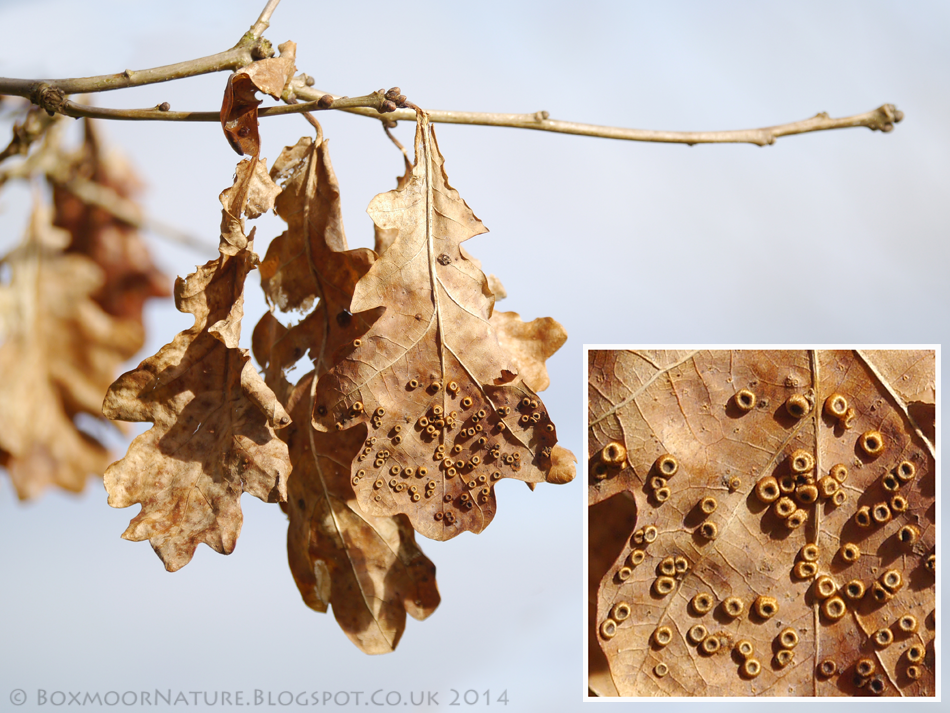
This young Oak tree wasn’t only hosting the Andricus kollari. There were signs of an additional infestation, this time on the dead leaves.


These are Silk Button Galls, created by the gall wasp species Neuroterus numismalis. They are always found on the underside of Oak leaves. Each gall contains one wasp lava and they should begin to emerge from now onwards.

On my way back to the car, I took the opportunity to photograph the flower buds of the Elm tree, showing the progress made in 3 weeks.


Next stop was Bulbourne Moor to photograph the Snowdrops.

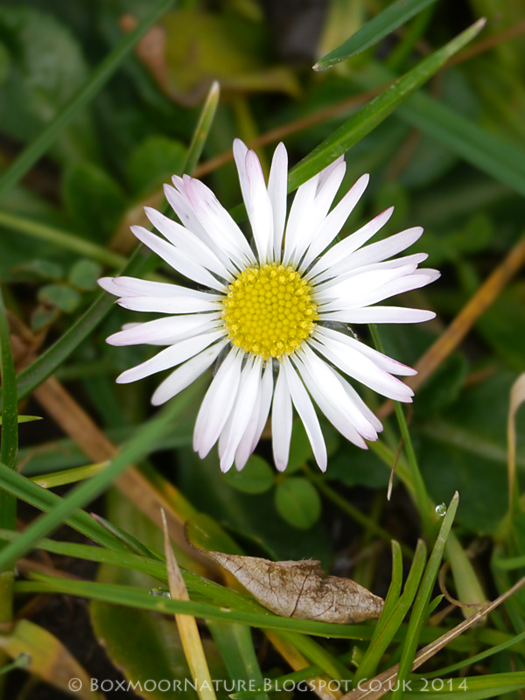
As I walked through Two Waters Moor (west), I was amazed to come across Common Daisies (Bellis perennis) in the grass. However, having done a little reading, I discovered that it’s not unusual for this species to produce a few flowers in mild winters. An interesting fact gleaned from Wikipedia:

“Although the 'flower' may appear to consist of a yellow centre with white petals, this is not the case. Each individual "petal" is itself an individual flower, called asterales. In the centre there are also many tiny yellow flowers. The different colours and styles of flower work together in order to attract insects. This type of flower is known as a composite flower.”

Out onto Bulbourne Meadow some flooding still remains and I spied a female Great Spotted Woodpecker, picking bark off a tree trunk, perhaps looking for insects. Unfortunately, a pair of Magpies chased her off before I could get within photographic range.


Finally I came to the Snowdrops (Galanthus nivalis). Spring is most definitely taking hold.