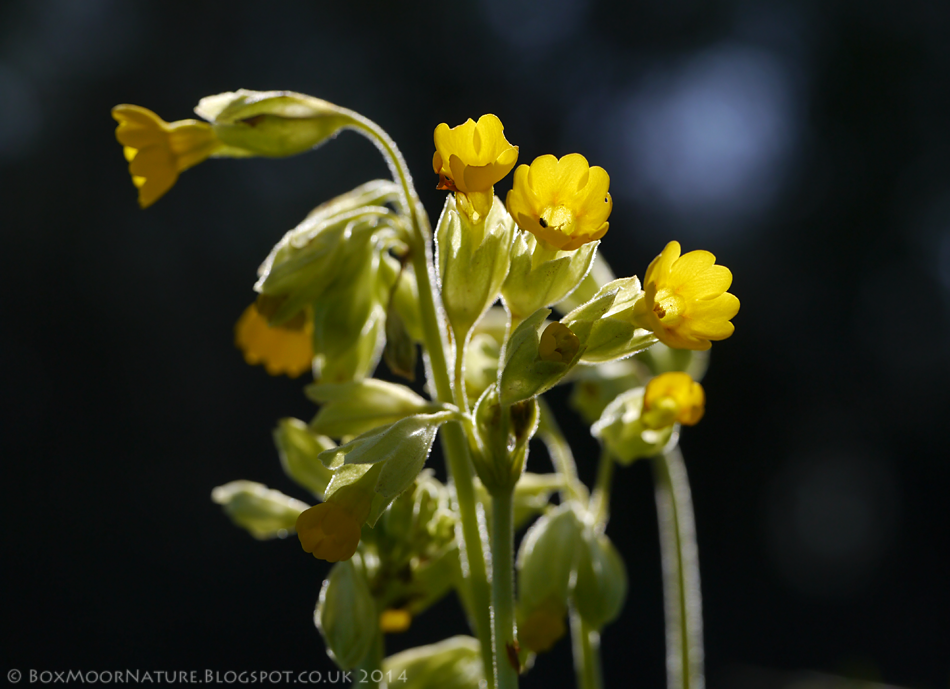
Showing posts with label Cowslip. Show all posts

Thursday, 31 July 2014

Week 28: Hemel Hempstead Barn Owls

Southern Hawker dragonfly, Bovingdon Brickworks (perched after hunting by the Buddleja)

    Southern Hawker, Brickworks
    Bramble blackberries, Brickworks

After fledgling Wagtails and nestling Swallows; riverside damsels and hunting dragonflies; meadows of moths and butterflies, I hadn’t got a clue what wildlife wonder I might encounter this week. In my wildest dreams, I don’t think I could have conjured up what transpired.

After months of not feeling up to going out beyond about 6pm, the sunset on Monday evening, combined with improved health, tipped the balance. Box Moor Trust land set against a fiery sky, seemed like a good plan. Of course, the inevitable happened. By the time I got out of the car, the colours had faded and the moment had passed. Still, it seemed a pity to waste escaping the house and so off I set. I debated whether or not to bother with the tripod but decided that if I left it in the car, I was bound to regret it.

I might have missed the sunset but I came across something far more exciting. Over the past month or so, there have been a number of Barn Owl sightings around Hemel Hempstead. On the Box Moor Trust Moth, Bat and Glow Worm evening (27th June), the group had enjoyed watching a bird quartering over the field between Chaulden Lane and the railway bridge. Dan Forder (of Hemel Birding fame) had seen a bird near the M1 Jun 8 on 7th July. And, on Monday evening, as I walked over Trust land, I chanced upon one of these beautiful creatures perched in a tree. It eventually took flight, soared silently over my head and away. Utterly magical and boy was I glad I had the tripod with me! The light was almost gone but I was able to get some ropey video footage before darkness fell. Special thanks to my talented Sister, her choir and the Robin soloist(!) for the backing track. A couple of years ago, on a sultry summer evening, the choir threw open the hall doors as they sang a cappella. Nature joined in. The resulting piece is candid and unique. A male Robin sings his evening song and the choir swells to accompany him.


Having done a little reading about Barn Owls, it seems to me that the females have the right idea. Grab yourself a monogamous mate and sit around all evening whilst he goes off and finds the food. Once eggs are laid, snuggle up inside the nest site, don't bother to build a nest (who needs twigs when regurgitated pellets will do?!), don’t bother to wash, and lap up meals-on-tap from the doting male. Result!


Ten Barn Owl Facts, shamelessly copied and pasted from the internet (with a few minor additions). More facts here.
  1. The barn owl was voted Britain’s favourite farmland bird by the public in an RSPB poll in July 2007. 
  2. Historically, the barn owl was Britain’s most common owl species, but today only one farm in about 75 can boast a barn owl nest.
  3. Barn owls screech, not hoot (that’s Tawny owls). 
  4. The barn owl can fly almost silently. This enables it to hear the slightest sounds made by its rodent prey hidden in deep vegetation while it’s flying up to three metres overhead.
  5. The barn owl’s heart-shaped face collects sound in the same way as human ears. Its ears are placed asymmetrically for improved detection of sound position and distance, and it does not require sight to hunt. Its hearing is the most sensitive of any creature tested.
  6. Barn owls are non-territorial. Adults live in overlapping home ranges, each one covering approximately 5,000 hectares. That’s a staggering 12,500 acres or 7,100 football pitches!
  7. It’s not uncommon for barn owl chicks in the nest to feed each other. This behaviour is incredibly rare in birds.
  8. In order to live and breed, a pair of barn owls needs to eat around 5,000 prey items a year. These are mainly field voles, wood mice, and common shrews. One of the most unusual feeding records is of a barn owl catching flying hawk moths.
  9. Though barn owls are capable of producing three broods of five to seven young each year, most breed only once and produce, on average, only two and a half young. 29 per cent of nests produce no young at all.
  10. 91 per cent of barn owls post-mortemed were found to contain rat poison. Some owls die as a direct result of consuming rodenticides, but most contain sub-lethal doses. The effects of this remain unknown.
Barn Owls are a Schedule 1 protected species. It’s fantastic that there appears to be a number of birds locally.


Finally, this week's oak...


And, Dellfield in Summer...


It seems incredible that just 3 months ago, this meadow was carpeted in Cowslips…

Friday, 11 April 2014

Week 12, Take Two: Sparkly Spawn & Sparring Songsters

I needed a second bite at the cherry. You probably guessed that I wasn’t altogether convinced by my Wednesday effort at the Oak photograph. With improving health this week, I returned to the scene of the crime yesterday morning. I give you “Dellfield Oak and Cowslips”....take two.


Length: approx 8mm. Dellfield, more Life amongst the Common Nettles 
The other itch that needed scratching was a desire to get some singing Blackcap footage. They really are little tinkers. Either, he tucks himself away in a bush, sits still, and sings his tiny heart out. Or, he flits from branch to branch, bursts of his discordant song left in his wake, and no sign of him settling for more than a second or two. Either scenario is entirely soul destroying when it comes to shooting video. Yesterday was no different! Almost.

At Bovingdon Brickworks, in the same area as I filmed the Chiffchaff last week, I came across 2 male Blackcaps going toe-to-toe over territory and mate. There is clearly something desirable about this location as Chiffchaff, Blackcap and Dunnock have all set up territories here. Lots of insect life, I expect. Anyway, the two male Blackcaps were chasing one another in and out of bushes. Up and down branches. From one tree over to another tree. Into the open. Then back into cover. Explosions of song from both contenders filling the air. I tried and failed miserably to get anything on film and walked on to see how the Common Frog spawn were doing. At least they couldn't fly away.


The tadpoles look as though an over enthusiastic 5 year old has come along with a tub of gold, silver and bronze glitter and made them All Pretty. The speckled appearance at this age is a sure sign that they are the Common Frog species.

When I returned to the Blackcaps, they had stopped chasing one another (a good start!), and, eventually (meaning, after getting lots of wobbly images of empty twigs and skinning my knuckle on the tripod, trying not to miss The Moment), I managed to get the footage below. Unfortunately, I was the wrong side of the gate when the bird flew into the bush beyond. It was a case of catching some distant footage....with an awkward viewpoint....through heat haze, or likely get nothing at all. If you spend the whole video wishing you could move the twig out of the way, you're not the only one! The sound of the brickworks in the background doesn’t help...and the Chiffchaff above my head drowned out the Blackcap at one point....but, hey, I think it’s better than nothing. Incidentally, a lady Blackcap arrived on the scene this morning so hopefully one of the males did enough to impress her.  Not to be left out, the Chiffchaff features at the end of the clip. Ironically, the Blackcap tried to sing over him! The Chiffchaff's reaction was priceless…complete indignation. I don't think the death stare was fatal but it made the point.  Singing louder seemed to be the weapon of choice.


P.S. The leaf buds on both the Oak and Ash trees are now just beginning to lengthen and/or expand, soon to burst. It feels as though almost every other tree has beaten them to it. More on that next week, perhaps.

Wednesday, 9 April 2014

Week 12: Ladybirds and Creepy Crawlies

The thick pea soup, sloshing around inside my skull where my brain should have been for the past 4 weeks, is slowly but surely giving way to a firing neuron or two. Don’t get too excited though. The process of composition is still faltering and glacial. Let’s just say you’re exceedingly fortunate not to receive the words in real time. Truly! You. Are.

I have been on the look out for ladybirds (Coccinella septempunctata) for a few weeks and finally discovered one of their hang outs. In a patch of succulent stinging nettles, by the north entrance to Dellfield, I unearthed numerous seven-spots (more than a dozen).


I was particularly careful not to disturb them. Why? Well, according to the internet literature, if these little creatures are startled or threatened, they secrete a foul smelling, toxic fluid (hemolymph) from their leg joints. If a predator is unlucky enough to encounter a Ladybird larvae, it will be faced with even worse, an abdomen oozing the sticky alkaloids. Grim. Best to steer clear of gobbling up brightly coloured red and black beetles. They are decidedly unpalatable and most birds, and other potential predators, will know (or quickly learn) to avoid meals that come in red and black packages.

A little more about Ladybirds before I move on. Traditionally, they are a gardener’s friend. They feed on all the little “pests” that vegetable and flower growers seek to be rid of: white flies, aphids, scale insects, mites and so on. In fact, legend has it that the prefix “lady” stems from this beneficent role. In the middle ages, European crops were plagued by pests. Farmers prayed to the Blessed Lady, the Virgin Mary, and along came Ladybirds, ridding the crops of the infestations and saving the Farmers’ livelihoods. From then onwards, the beetles became known as Lady Beetles or, in Germany, Mary Beetles (Marienkafer). The name eventually morphed into Ladybirds and Ladybird Bettles.

If you’re scared of spiders, beware the next few photographs. Once you get down and dirty in a patch of stinging nettles you will find all sorts of marvellous creepy crawlies. I lost count of the number of Nursery web spiders which had positioned themselves in warm, sunny spots on nettle leaves. I also came across this curious tiny “thing” (photographed right). It was approximately 2mm in length and, according to the clever people on the internet, it is a mummified aphid. Essentially, a parasitoid wasp has laid its egg in the aphid. I wonder if a Ladybird will come along and eat both the aphid and the incubating wasp egg *shudder*. I’m reminded of the song “I know an old lady who swallowed a fly”...perhaps it isn’t so unrealistic after all.

Clearly, the nettles were the place to dine. A common species of hoverfly also turned up, which was no doubt on the look out for aphids as well. (To enlarge the photographs, just click on them).

    Nursery Web Spider
    Hoverfly (Platycheirus albimanus)
    Nursery Web Spider


It was all too easy to get absorbed into the microcosm of life within the nettles. But, elsewhere, all around the moorland, there are glowing Meadow Buttercups (the photograph below was taken on Station Moor)


Not far from where I found the Forget-me-not last week, a profusion of beautiful Hidcote Comfrey has burst into life. And, Cowslips are out in abundance now. Dellfield, the London Road verge (along Snook's Moor), and the Bovingdon Brickworks are suffused with the tiny yellow flowers.

    Hidcote Comfrey (Bovingdon Brickworks)
    Cowslips (Bovingdon Brickworks)

Walking through Snoxall's Moor, it's hard not to notice the pair of striking trees (photographed below, left). From a little research, I think they are Acer pseudoplatanus (Sycamore Maple) but happy to be corrected, if anyone can help. Whatever they are, when caught in the right light, they look most elegant and dramatic. Finally, to this week's Oak photograph. I can't say it's a roaring success but in as much as I wanted to capture the Cowslip-rich slope, leading down to the Oak, it works. As a footnote, for the birder in me, I've included a shot of the Grey Heron which frequents the canal by Bulbourne Moor.

    Acer pseudoplatanus
    Dellfield Oak
    Grey Heron