Showing posts with label Health Issues. Show all posts

Wednesday, 16 April 2014

Week 13: Leaf Buds & Jazzy Flies


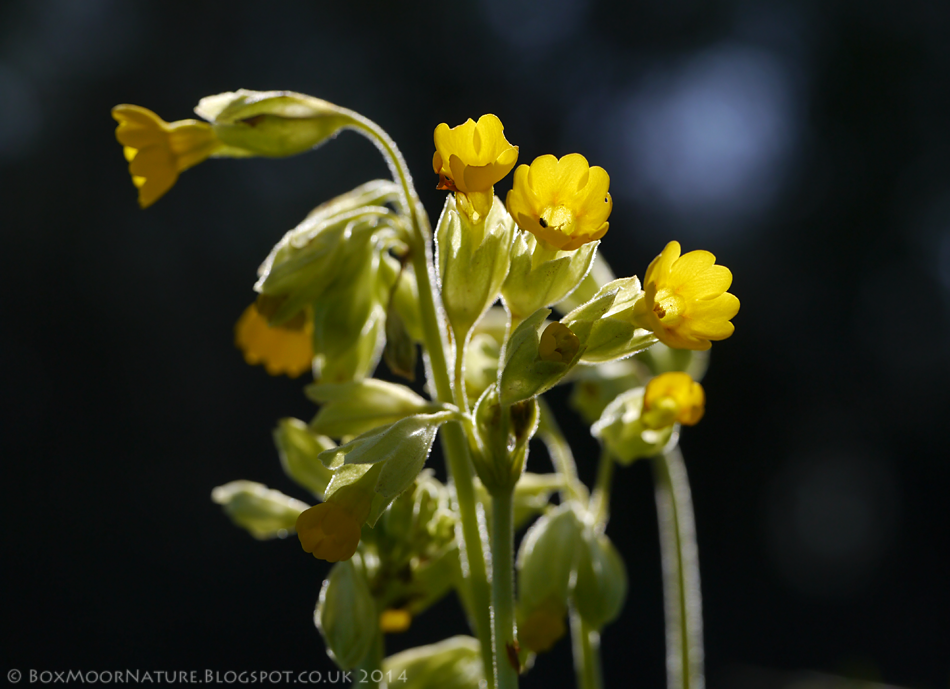
Something a little different this week. Not planned. More a case of responding to circumstances. It's a bit of a hotchpotch, really. The good news is that I did manage an Oak photograph (above) and another snap of the wonderful Cowslips (below). It was bright, crisp and utterly glorious yesterday morning with the frosty air around the Oak filled with the song of Blackcap, Dunnock, Wren and Blackbird, amongst others.  However, visiting the Oak was as much as I could manage, so, everything else is gleaned from the previous few days.

The irresistable carpet of Cowslips covering Dellfield


The Oak's leaf buds are finally making a move.

Below, is a heavy crop of the shot taken on February 19th. Right, is Friday's shot of the same cluster of buds. The terminal bud has begun to lengthen. Leaf burst won't be far behind.

        19th Feb
    11th April


On Friday, a few of the Ash buds were similarly just beginning to expand and break open their sooty bud cases.

After the Oak and Ash, the Beech tree is the last of the UK native species to come into leaf, I think, but I could be wrong. Anyway, it's lovely to finally see them responding to the lengthening days and increasing temperatures.


On Monday, I was able to get out briefly around Bulbourne Meadow and, in another patch of lively stinging nettles, I came across a number of Yellow Dung Flies (Scathophaga stercoraria). The mention of “dung” and “flies” is no reason to stop reading and skip to the picture, ok….(unless you’re eating, in which case, do, please, skip to the picture!). The name derives from the fact that females lay their eggs on animal dung and the newly hatched larvae then burrow into, and feed on said dung, before moving off to pupate. Now..., there’s a creature I do not envy! The males spend the majority of their time hanging around on cow pats (or similar!), waiting for frisky females to be attracted by the stench, I mean scent. It’s a dirty job but someone has to do it! In fact, as with many processes and relationships in the natural world, the Dung fly’s role is vital. Breaking down and recycling the faeces of large animals is decidedly helpful, especially where irresponsible dog owners have clearly passed through (like Monday). The flies feed mainly on other smaller insects and on nectar. Human food doesn’t interest them and, unlike other types of fly, they do not come indoors, so they are not likely to be responsible for the spread of disease etc. All in all, a handy little bug to have around and a cheerful bright yellow, with matching fur, to boot. Need a girl ask for more?!


Finally, a very happy Easter and, if you’re looking for a short-ish wander over the weekend, the Bluebells and Lesser Celandine are flowering beautifully in Hay Wood (I just haven’t been able to get there to photograph them yet). You could try one of the Box Moor Trust walks. Both the Green Walk and the Orange Walk take in Hay Wood.

Wednesday, 9 April 2014

Week 12: Ladybirds and Creepy Crawlies

The thick pea soup, sloshing around inside my skull where my brain should have been for the past 4 weeks, is slowly but surely giving way to a firing neuron or two. Don’t get too excited though. The process of composition is still faltering and glacial. Let’s just say you’re exceedingly fortunate not to receive the words in real time. Truly! You. Are.

I have been on the look out for ladybirds (Coccinella septempunctata) for a few weeks and finally discovered one of their hang outs. In a patch of succulent stinging nettles, by the north entrance to Dellfield, I unearthed numerous seven-spots (more than a dozen).


I was particularly careful not to disturb them. Why? Well, according to the internet literature, if these little creatures are startled or threatened, they secrete a foul smelling, toxic fluid (hemolymph) from their leg joints. If a predator is unlucky enough to encounter a Ladybird larvae, it will be faced with even worse, an abdomen oozing the sticky alkaloids. Grim. Best to steer clear of gobbling up brightly coloured red and black beetles. They are decidedly unpalatable and most birds, and other potential predators, will know (or quickly learn) to avoid meals that come in red and black packages.

A little more about Ladybirds before I move on. Traditionally, they are a gardener’s friend. They feed on all the little “pests” that vegetable and flower growers seek to be rid of: white flies, aphids, scale insects, mites and so on. In fact, legend has it that the prefix “lady” stems from this beneficent role. In the middle ages, European crops were plagued by pests. Farmers prayed to the Blessed Lady, the Virgin Mary, and along came Ladybirds, ridding the crops of the infestations and saving the Farmers’ livelihoods. From then onwards, the beetles became known as Lady Beetles or, in Germany, Mary Beetles (Marienkafer). The name eventually morphed into Ladybirds and Ladybird Bettles.

If you’re scared of spiders, beware the next few photographs. Once you get down and dirty in a patch of stinging nettles you will find all sorts of marvellous creepy crawlies. I lost count of the number of Nursery web spiders which had positioned themselves in warm, sunny spots on nettle leaves. I also came across this curious tiny “thing” (photographed right). It was approximately 2mm in length and, according to the clever people on the internet, it is a mummified aphid. Essentially, a parasitoid wasp has laid its egg in the aphid. I wonder if a Ladybird will come along and eat both the aphid and the incubating wasp egg *shudder*. I’m reminded of the song “I know an old lady who swallowed a fly”...perhaps it isn’t so unrealistic after all.

Clearly, the nettles were the place to dine. A common species of hoverfly also turned up, which was no doubt on the look out for aphids as well. (To enlarge the photographs, just click on them).

    Nursery Web Spider
    Hoverfly (Platycheirus albimanus)
    Nursery Web Spider


It was all too easy to get absorbed into the microcosm of life within the nettles. But, elsewhere, all around the moorland, there are glowing Meadow Buttercups (the photograph below was taken on Station Moor)


Not far from where I found the Forget-me-not last week, a profusion of beautiful Hidcote Comfrey has burst into life. And, Cowslips are out in abundance now. Dellfield, the London Road verge (along Snook's Moor), and the Bovingdon Brickworks are suffused with the tiny yellow flowers.

    Hidcote Comfrey (Bovingdon Brickworks)
    Cowslips (Bovingdon Brickworks)

Walking through Snoxall's Moor, it's hard not to notice the pair of striking trees (photographed below, left). From a little research, I think they are Acer pseudoplatanus (Sycamore Maple) but happy to be corrected, if anyone can help. Whatever they are, when caught in the right light, they look most elegant and dramatic. Finally, to this week's Oak photograph. I can't say it's a roaring success but in as much as I wanted to capture the Cowslip-rich slope, leading down to the Oak, it works. As a footnote, for the birder in me, I've included a shot of the Grey Heron which frequents the canal by Bulbourne Moor.

    Acer pseudoplatanus
    Dellfield Oak
    Grey Heron

Tuesday, 25 March 2014

Week 10: Glory of the Grass Verge

This week, my brain is about as useful as a soggy tissue pulled from the pocket of wet jeans, fresh out of the washing machine. Hopefully the pretty pictures will compensate for barely being able to string a sentence together (and don’t ask me how long it took to come up with that opener! The answer "too long" is a serious understatement). OK, so, firing on half a cylinder at best, I stuck to Dellfield and its surrounding fields, yesterday. Over the last couple of weeks, a variety of small, early spring flowers have steadily emerged. Primroses, Wood Dog Violets, Cowslips and Meadow Buttercups have joined the Daffodils and Grape Hyacinths dotted around the Box Moor lands. And, yesterday, I finally remembered to go and look at another little flower I’d noticed growing along the grass verge leading to the Dellfield carpark. In the morning’s brilliant sunshine, they looked like miniature starbursts and would very definitely live up to their name, “Glory of the Snow”, should the white stuff descend. (To enlarge the smaller images, just click on them).

Glory of the Snow (Chionodoxa)


Leaf buds are bursting open now on many trees, although the Oak will be a while yet. At the south end of Bovingdon Reach, there is a rather mighty Horse Chestnut, its skeleton just beginning to carry splashes of colour. Unfortunately, I couldn’t capture its sense of fresh decoration on camera so you have the tree in black and white (right) and the beautiful, new leaves in colour (below)

High over head, 2 Buzzards were circling and calling and a Red Kite hovered. A Mistle Thrush was sunning itself on the ground, turning its head towards the warmth and seemingly closing its eyes in pleasure. Without slipping further into anthropomorphism, I reckoned this rattler had the right idea and I could have happily sat alongside and soaked up some rays as well.

Horse Chestnut (Aesculus hippocastanum)


Through the woods, towards Preston Hill, I was looking up into a still leafless canopy.


Approaching Preston Hill pond frequently results in me accidentally disturbing a bathing Blue Tit. It always chooses the same spot and we always surprise one another! Today, I decided to check the pond more carefully from a distance before approaching. No Blue Tit but, in its place, something a little more exciting, a male Grey Wagtail. In fact, it was a pair of Grey Wagtails, likely on their way to find a place to breed. They only stayed a minute or two but it made my morning. This was the first time I’d seen this species on Box Moor land. The photograph (right) shows the male, with his developing black throat unfortunately hidden from view.

Finally, this week’s Oak photograph is again not for the purists. With the tree in its leafless state, I find I’m drawn more to its shape and the structures of its setting. To the original image (which I’ve included for reference), I applied a dark blue, inverted gradient filter in PSE. I’m currently not able to go wandering around at night (well, not on purpose anyway) so this is me improvising.


The Oak by Moonlight (sort of)

Sunday, 2 March 2014

Week 6, Part 3: Short but Pretty

I confess, Wednesday’s early morning has taken its toll. Week 6, Part 3 will appear here at some point in the not too distant future (I hope).
[Edit: post now complete, follows below]

By way of explanation, I have various limiting health issues, which mean I need to manage my resources rather carefully. Sometimes my enthusiasm leads me to exceed my capacities and I have to put things on hold until I've recovered. I have no doubt that my blog output will be characterised by peaks and troughs, much to my frustration. For now, though, I’ll leave you with the sunny view across Bulbourne Meadow, towards the KD Tower. I'm looking forward to being able to repeat this shot when the trees are all dressed up in their lovely leaves.


The Real “Short but Pretty” Post


Hopefully this is a case of better late than never.

After spending far too long transfixed by rascally little lambs, I headed over to Bulbourne Meadow. I had a particular shot in mind, involving the fallen branches in the River Bulbourne (featured in this post). More specifically, I was after the “short but [ever so] pretty” moss which covered the branch in the bottom left hand corner of that photograph. This was the result...


The closer I looked at the moss, the more beautiful it became, glistening in the morning sunshine.


And finally, the closest view I could capture without a macro lens


Although very familiar with the sight of this moss - it is “common and widespread” - I didn’t know its name or, indeed, anything about mosses per se. I guess you could say this was my first formal introduction to Capillary Thread-moss (Bryum capillare).

For fellow initiates, two key facts about Mosses

1. They are bryophytes or non-vascular plants i.e. they don’t have a water bearing system which takes moisture from the soil up through the plant. Instead, water and nutrients are primarily absorbed through their photosynthesising leaves.

2. They reproduce via spores not seeds and they don’t flower. They can also reproduce from broken off parts of the parent plant (ouch!).

Hearing facts is one thing. Seeing them is another, so, thankfully the second of the above is easily anchored in reality. Taking a look at the close up of the Bryum capillare above, the vibrant green, pear-shaped pendulous structures, suspended from the relatively long, red stems or setae, are the spore-filled capsules. At this time of year they are nice and easy to spot. Over the coming weeks, they will ripen, turning a chestnut brown, before the end caps break away and the spores are released.

Although not possible to see (without a microscope) the first of the facts is the reason why peat mosses (Sphagnum species) were applied to wounds during World War I. Their wonderfully absorbent leaves and antibacterial properties made for an effective (at that time!) first aid dressing.

So, only another 10,000 or so species of moss to discover...!